Introduction
The global energy transition is confronting a difficult reality: some of the world’s most important industries are also among the hardest to decarbonise. Aviation and shipping cannot easily rely on conventional electrification, creating an urgent need for scalable, credible alternatives to fossil fuels.
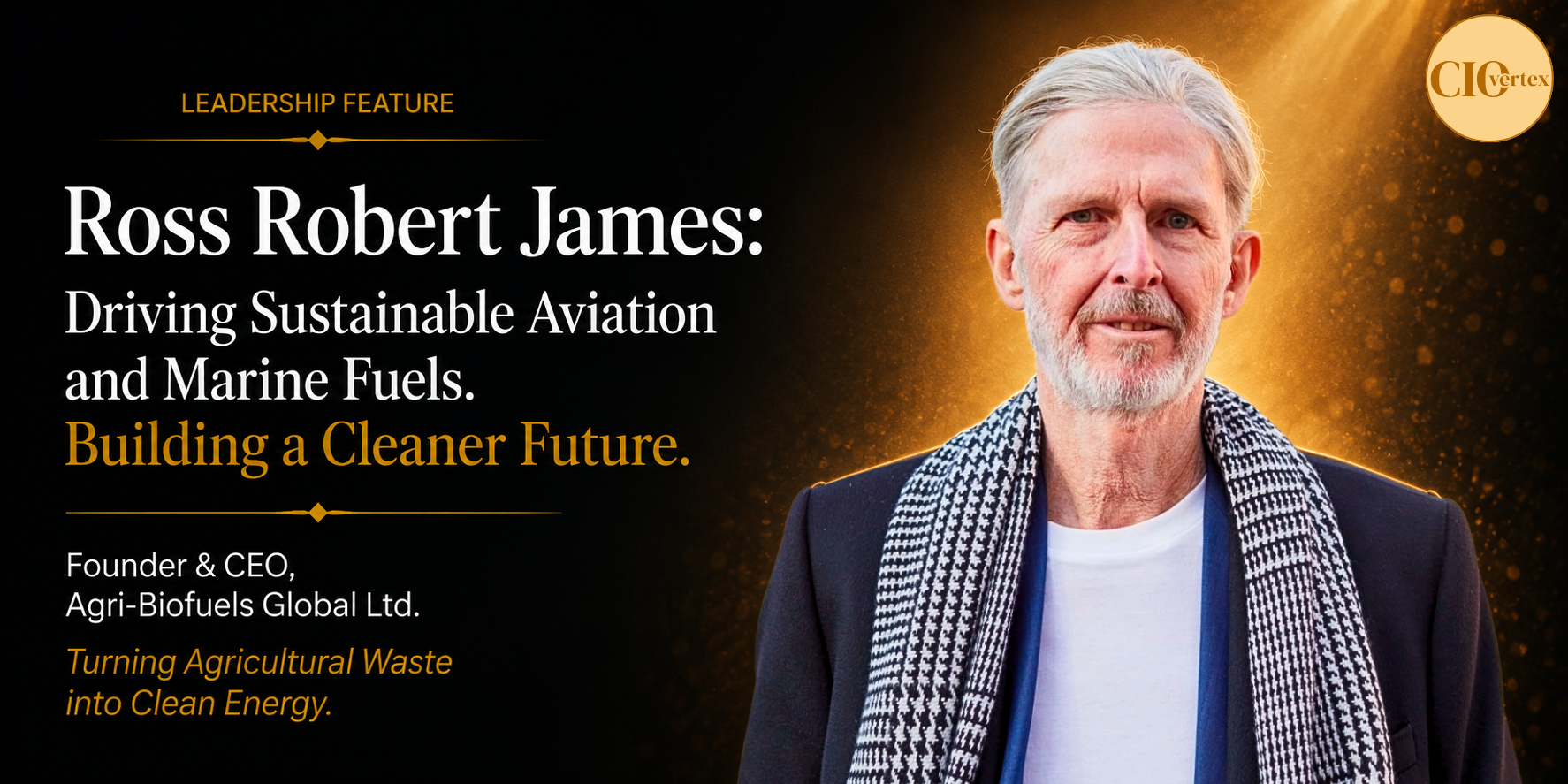
For Ross Robert James, Founder & CEO of Agri-Biofuels Global Ltd, the answer began not in a boardroom, but in the agricultural fields of India.
While working in India, Ross repeatedly encountered vast quantities of agricultural residue and by-products being burned, discarded, or left to decompose. What appeared to be waste represented something much more valuable, a largely untapped feedstock for a new generation of sustainable fuels.
As he explored agricultural regions across sub-Saharan Africa, he discovered a similar pattern. At the same time, aviation and shipping were facing growing pressure to reduce their emissions, yet scalable low-carbon fuel alternatives remained limited.
Ross saw an opportunity where two seemingly separate challenges intersected: agricultural waste could become a resource for decarbonising the sectors that need sustainable fuels most.
That realisation became the foundation for Agri-Biofuels Global Ltd.
From Recognising the Problem to Building the Solution
Ross describes the current chapter of his career as the transition from analysis to execution.
The founding of Agri-Biofuels Global marked a decisive step toward addressing the challenge he had identified. A pivotal milestone came when the company secured an exclusive licence for India to a hydrothermal liquefaction (HTL) process capable of converting wet agricultural residue into a crude-oil substitute.
Rather than pursuing unscaled experimental science, Agri-Biofuels Global focuses on commercially proven HTL technology. The combination of established technology, access to agricultural feedstock, and the scale of the Indian market provides the company with a foundation from which to pursue commercial development.
Ross, however, remains deliberately measured about the journey ahead.
A licence is not an operating plant, and he is clear about the distance between securing technology and achieving commercial production. For him, credibility comes from acknowledging that distinction while continuing to build toward the end goal.
Turning Agricultural Residue into Opportunity
At the heart of Agri-Biofuels Global’s model is a simple but powerful proposition: what farmers currently regard as waste can become an economic resource.
The company is focused on agricultural residues such as sugarcane bagasse and other by-products left behind after crops are harvested. Rather than competing with food production, the model seeks to utilise material that already exists as part of agricultural activity.
This distinction is central to Ross’s vision.
Instead of relying exclusively on a limited pool of conventional waste oils, the company sees agricultural residue as a significantly broader and less-contested feedstock opportunity.
The potential benefits extend beyond fuel production. A successful model could create additional value for agricultural communities, generate local employment, reduce open-field burning, and contribute to cleaner air while supporting the production of lower-carbon fuels for hard-to-abate industries.
Building Partnerships with Governments
One of the milestones Ross is most proud of is not a financial figure or a headline announcement, but the confidence demonstrated by public-sector partners.
Agri-Biofuels Global has signed memoranda of understanding with several state governments in India’s north-east, with formal agreements progressing toward signing.
The proposed model is designed to align government participation with local economic benefits. Under the structure being developed, state governments would take an equity stake in their own plant without upfront cash investment while sharing in the resulting returns.
For Ross, securing the interest of sophisticated public-sector counterparts represents an important validation of the underlying concept.
The proposition is straightforward: transform agricultural residue into aviation and marine fuel while creating economic value within the communities where the feedstock originates.
Turning that concept into formal partnerships, however, required years of relationship-building, communication, and persistence.
The Real Challenge Is Supply
Ross believes one of the most significant misconceptions surrounding sustainable fuels is that demand is the primary challenge.
In his view, demand is increasingly being driven by regulatory requirements across major markets, including the UK, Europe, and parts of Asia. The more difficult question is how to develop sufficient, reliable, and scalable supply.
That brings the conversation back to feedstock.
Much of the sustainable-fuel industry continues to compete for a relatively narrow pool of waste oils. Agri-Biofuels Global is taking a different approach by focusing on agricultural residues that exist in substantial quantities across major agricultural economies.
The company therefore sits at the intersection of agriculture, energy, technology, and infrastructure, industries that must work together if sustainable fuel production is to reach meaningful scale.
Purpose as a Renewable Source of Energy
Building a pre-revenue infrastructure company is not easy. Product development, funding, partnerships, regulatory considerations, and commercialization can create a constant headwind.
Yet Ross remains motivated by two forces.
The first is the scale of the challenge itself.
Decarbonising aviation and shipping represents one of the most difficult components of the global energy transition. Developing a solution that simultaneously creates value from agricultural waste gives the opportunity an additional dimension.
The second is the human impact.
Every time a farmer, government official, or investor recognises that material once considered waste can become an economic resource, Ross sees renewed evidence that the model has the potential to create meaningful change.
For him, purpose itself becomes a renewable source of energy.
Redefining What Success Means
Ross’s understanding of success has evolved considerably throughout his career.
Earlier, success was largely measured through scale, speed, and the ability to accomplish more in less time. Today, he places greater value on durability.
His ambition is to build something that remains relevant decades from now, an enterprise that continues generating value for communities long after the initial headlines disappear.
In practical terms, that means building plants that operate successfully, creating additional income opportunities for farmers, generating employment, and producing fuels capable of genuinely reducing emissions in hard-to-abate sectors.
Rather than announcing ten ideas that never become reality, Ross would rather build one meaningful solution that stands the test of time.
That philosophy also shapes his approach to communication: claim what is true, acknowledge what remains uncertain, and allow results to speak for themselves.
Integrity and the Long View
Two principles sit at the heart of Ross’s approach: integrity and patience.
In an industry filled with ambitious projections and long-term promises, he believes credibility is earned by being willing to state the smallest thing that can be proven rather than the largest thing that might eventually be possible.
The second principle is taking the long view.
Infrastructure development does not happen overnight. Building sustainable fuel capacity requires technology, financing, partnerships, infrastructure, regulatory alignment, and community participation.
Ross understands that progress must therefore be measured in years rather than quarters.
As an Australian who has made the UK his home, he is particularly interested in building an enterprise with roots in growth economies where the social and economic benefits can be substantial.
In many ways, the company’s journey begins exactly where his vision began: in the farmer’s field.
Creating Value Beyond Carbon Reduction
The opportunity Ross sees is broader than simply replacing fossil fuels.
If agricultural residues can become feedstock for sustainable aviation and marine fuels at commercial scale, the resulting ecosystem could connect farmers, governments, technology providers, investors, energy companies, and global transport industries.
Such a model has the potential to create value across the entire chain.
For agricultural communities, it can create an additional market for residue. For governments, it can support economic development and environmental objectives. For the energy sector, it can expand the available feedstock base. And for aviation and shipping, it can contribute to the development of alternatives for emissions-intensive operations where electrification remains challenging.
Agri-Biofuels Global is therefore pursuing a model in which environmental progress and economic opportunity reinforce one another.
Building for the Future
Looking ahead, Ross’s focus is firmly on execution.
The company is working toward developing its first commercial plants, advancing government partnerships, bringing initial products to market, and establishing the infrastructure necessary to scale its technology.
The journey remains at an early stage, and Ross makes no attempt to disguise that fact. Agri-Biofuels Global is currently pre-revenue, and the transition from technology licensing and partnerships to operating commercial facilities remains a significant undertaking.
But that realism is precisely what defines his approach.
He is not interested in building a company around promises. He is interested in building an enduring business around a genuine problem, a viable technological pathway, strong partnerships, and measurable outcomes.
A Philosophy for Purposeful Work
Ross’s advice to aspiring entrepreneurs and professionals is rooted in the same principles that guide his own journey.
Solve a problem that would still matter if nobody were watching.
Trends may create attention, but genuine usefulness creates lasting value.
Purposeful work, particularly when it involves infrastructure, sustainability, or systemic change, requires patience because meaningful results often take years to materialise.
He also believes credibility should be treated as one of the most valuable assets any professional can possess.
Say what is true. Clearly identify what remains uncertain. Avoid overstating progress.
Then allow the work itself to demonstrate its value.
For Ross Robert James, the mission of Agri-Biofuels Global is ultimately about turning an overlooked resource into something transformative: converting agricultural residue into sustainable fuel, creating economic opportunity for communities, and helping some of the world’s hardest-to-abate industries move toward a cleaner future.
The journey from field waste to commercial fuel will take time. But for Ross, that is not a reason to wait—it is a reason to build with greater discipline, greater honesty, and a longer view.

ABOUT ROSS ROBERT JAMES
Founder & CEO of Agri-Biofuels Global Ltd, Ross Robert James is a sustainability entrepreneur focused on transforming agricultural waste into sustainable fuels for aviation and marine industries. His vision combines clean energy innovation with economic opportunities for agricultural communities and a cleaner future.