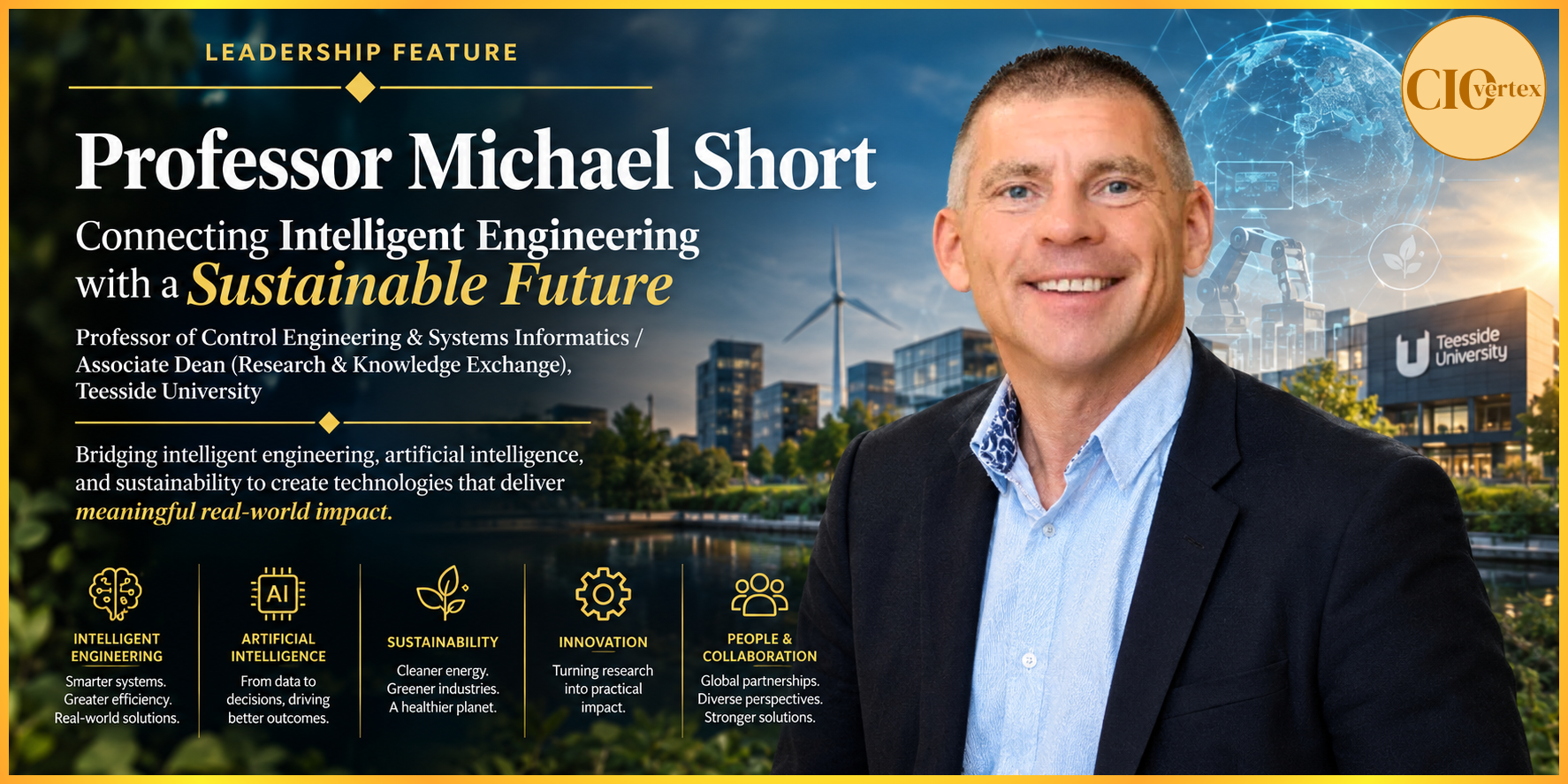
Professor of Control Engineering & Systems Informatics / Associate Dean (Research & Knowledge Exchange), Teesside University
Bridging intelligent engineering, artificial intelligence, and sustainability to create technologies that deliver meaningful real-world impact
Introduction
Engineering has always been about understanding how things work. But for Professor Michael Short, the more interesting question has always been what could happen if those things were made to work differently.
That curiosity began early, with experiences on the ZX Spectrum and a fascination with robotics and platforms such as LEGO Mindstorms. The ability to combine mechanics, electronics, and software and then watch a machine respond intelligently to its environment opened up a world of possibilities.
Decades later, that same curiosity continues to shape his work.
Today, Professor Short operates at the intersection of control engineering, artificial intelligence, robotics, energy, digitalisation, and sustainable engineering, combining academic research with industry collaboration, research leadership, knowledge exchange, and entrepreneurial activity.
His career has evolved from developing intelligent engineering systems to helping create the conditions in which research can generate impact at much larger scales.
The technologies may have changed dramatically from early computing and robotics to AI, digital twins, IoT, autonomous systems, and Industry 5.0 but the underlying question remains remarkably consistent:
How can we make complex systems behave more intelligently, efficiently, and usefully for the people and organisations that depend on them?
Increasingly, Professor Short has added another dimension to that question:
How can those technologies help make society and industry more sustainable?
It is at that intersection of intelligent engineering, people, and sustainability that his work continues to evolve.
The Spark: From Early Computing to Intelligent Engineering
Professor Short’s interest in engineering began with a fascination for understanding how things worked and, more importantly, how they could be made to work differently.
Some of his earliest experiences with computing came through the ZX Spectrum. Later, robotics and platforms such as LEGO Mindstorms captured his imagination by demonstrating how mechanics, electronics, and software could work together to create systems capable of responding intelligently to the world around them.
That early fascination eventually led him toward a technical apprenticeship, followed by work as a production and process engineer and later as a specialist in control engineering, robotics, and artificial intelligence.
His academic journey took that interest further.
During his PhD, Professor Short worked in robotics and AI, including developing a planar robotic system and intelligent approaches to its control.
The question that fascinated him then remains central to his work today: engineering becomes particularly powerful when the physical and digital worlds are connected.
Technology has transformed enormously since those early experiences. AI, digital twins, autonomous systems, IoT, and Industry 5.0 now represent increasingly important areas of technological development.
Yet Professor Short sees a strong continuity between those emerging technologies and the curiosity that first drew him into engineering.
The tools have changed.
The fundamental challenge has not.
It is still about making complex systems more intelligent, efficient, useful, and ultimately more valuable to the people and organisations they serve.
What has expanded is the responsibility surrounding that innovation.
Today, Professor Short is equally interested in how those technologies can be adapted to address sustainability challenges bringing intelligent engineering together with environmental and societal objectives.
From Research Practice to Research Leadership and Impact
Professor Short describes his current career chapter as a transition from research practice to research leadership and impact generation at larger scales.
Much of his career has been devoted to developing and applying research across control systems, AI, energy, robotics, and sustainable engineering.
Today, his role increasingly involves connecting these disciplines and creating partnerships capable of translating ideas into genuine economic, environmental, and societal impact.
It is also about creating the right conditions for others to succeed.
At Teesside University, his leadership responsibilities in research and knowledge exchange have given him the opportunity to work across disciplines and engage with a broad range of external organisations.
That work has taken him into environments spanning industrial manufacturing and energy systems, maritime engineering, and healthcare.
His international collaborations have included projects connected with ADNOC in Abu Dhabi, while more recent work has involved digital transformation activities with the NHS at the Royal London Hospital.
Across these different environments, one lesson has become increasingly clear.
The most important engineering challenges rarely fit neatly inside a single academic discipline or within universities alone.
Sustainability is not simply an energy problem.
AI is not simply a computer science problem.
Industrial digitalisation is not simply an automation problem.
These are interconnected challenges involving technology, economics, infrastructure, organisations, and, crucially, people.
Recognising that interconnectedness has increasingly taken Professor Short beyond traditional academic boundaries.
It has also influenced his entrepreneurial work, where AI, digitalisation, and Industry 5.0 thinking are being explored as practical tools for helping organisations transform.
Turning Engineering Research into Real-World Impact
For Professor Short, achievement has never been about a single isolated moment.
He places greater value on progression on seeing research, ideas, and expertise develop into something capable of creating tangible change.
Being promoted to Professor in 2020 was therefore a significant milestone, as was being recognised twice in the UK Digital Leaders Top 50, in 2023 and again in 2025.
But the significance of those achievements lies less in the recognition itself and more in what it represents.
His work has consistently focused on applying engineering research to real-world challenges, particularly around sustainability and industrial transformation.
His research has explored how industrial processes can transition from natural gas toward hydrogen, how renewable energy can support manufacturing, agricultural, and water systems, how smarter controls can reduce building energy consumption, and how alternative propulsion and fuels can contribute to the decarbonisation of maritime transport.
One project captures the practical nature of that approach particularly well.
The question sounds almost light-hearted:
Can we still eat crisps in a zero-emission, sustainable future?
Behind that question, however, sits a serious industrial challenge involving process heat, fuel substitution, control, economics, logistics, and carbon emissions.
Research into the decarbonisation of industrial crisp production examined how hydrogen could potentially transform such processes while retaining the industrial functionality required helping to “take the carbon out of hydrocarbons.”
For Professor Short, this is where engineering research becomes most rewarding.
A paper or article can contribute to knowledge.
But when rigorous research begins influencing something tangible an industrial process, a technology, an organisation, or society—the potential impact becomes much greater.
Curiosity as a Source of Momentum
Research and innovation rarely follow a predictable path.
Experiments fail. Funding applications are unsuccessful. Papers and articles are rejected. Technologies behave unexpectedly. Projects evolve in ways that were never anticipated at the beginning.
For Professor Short, however, uncertainty is not simply an obstacle.
It is part of what makes the work interesting.
Curiosity remains one of his strongest sources of motivation.
If he encounters a problem he does not immediately know how to solve but believes is solvable he is motivated to investigate it.
That mindset has sustained him through an academic and professional career spanning multiple disciplines and international environments.
Working with talented people from different backgrounds is another major source of energy.
Professor Short has taught, collaborated, and engaged internationally across regions including the EU, Europe, India, Malaysia, China, and the Middle East. These experiences have reinforced how differently people can approach the same problem and how much can be learned through those differences.
Redefining Success: From Achievement to Legacy
Professor Short’s understanding of success has evolved considerably throughout his career.
Earlier in an academic career, success can appear relatively straightforward to measure: qualifications, publications, PhD graduations, citations, grants, and eventually promotions.
These indicators remain important. They provide evidence of quality and credibility and can create opportunities for further research, leadership, and development.
But at a more senior level, his definition of success has broadened.
Today, he thinks increasingly in terms of impact and legacy.
Did the research change something?
Has someone used an equation or method to do something useful?
Did it help an organisation become more sustainable or productive?
Did it create an opportunity for a student or researcher?
Did it establish a partnership that continues beyond the original project?
Did an interesting idea become something people can actually use?
One particularly striking example demonstrates the potential of research to travel far beyond its original academic context.
An analytical concentration inequality Professor Short developed and published was subsequently picked up and directly contributed to the development of a new, accurate, and low-cost DNA sequencing test for trisomies such as Down syndrome and Edwards syndrome, which was later commercialised in the United States.
For him, knowing that an idea developed through research has made a tangible difference provides a reward that extends far beyond any financial value.
Leadership has added another dimension to this definition of success.
Increasingly, success means creating the conditions in which other people can succeed.
A strong research environment, meaningful connections between talented people, and the freedom and confidence to pursue ambitious ideas can produce a collective outcome far greater than anything one individual could achieve alone.
The measure, therefore, is not simply what has been accumulated.
It is the momentum created.
Leaving people, organisations, and systems better positioned than when they were encountered.
Beyond Automation: Putting People at the Centre of AI
One of the most persistent misconceptions about AI and automation is that their primary purpose is to replace people.
Professor Short considers that an unnecessarily narrow interpretation.
His interest lies much more strongly in human-centric automation, an approach central to the emerging concept of Industry 5.0.
The question should not simply be:
“What can we automate to make more money?”
It should also be:
“How can technology make people safer, more capable, more productive, and better informed?”
Healthcare provides a powerful example.
Professor Short and his collaborators are exploring intelligent facilities-management concepts in which sensors, computer vision, IoT systems, analytics, and robotics could improve how buildings are operated.
But in an environment such as a hospital, technology must support clinical and facilities/support staff in achieving better outcomes rather than simply attempting to remove humans from decision-making altogether.
The same principle applies to manufacturing.
AI can identify patterns that humans may not readily see. Robots can undertake repetitive or hazardous operations. Digital twins can explore thousands of potential scenarios before physical changes are made.
But human judgement, creativity, responsibility, and contextual understanding remain essential.
For Professor Short, these qualities need to remain part of the supervisory control loop.
The future he sees is therefore not simply a competition between human and machine intelligence.
It is a collaboration between the two.
Can a machine learn to be “wise”?
That remains an open and deeply philosophical question.
Modern approaches may allow machines to mimic the behaviour of a very wise person remarkably well, but Professor Short points to the continuing uncertainty around what fundamentally differentiates organic neural systems from their simulated counterparts.
There is still much that science does not fully understand.
And that uncertainty, once again, creates another reason to remain curious.
The Human Dimension of Engineering
For Professor Short, engineering has never existed in isolation from society.
His professional values curiosity, openness, authenticity, and a willingness to keep learning extend well beyond the laboratory, university, or research environment.
International experience has played a particularly important role in shaping his perspective.
Travel and exposure to different countries and cultures have demonstrated how differently people can approach technology, leadership, collaboration, and problem-solving.
He also values authenticity.
Academic and professional environments can sometimes create the impression that successful careers follow perfectly planned trajectories.
His own career demonstrates otherwise.
Some of the most interesting opportunities have emerged unexpectedly from conversations, collaborations, travel, or simply being willing to explore an idea outside his immediate field.
Maintaining interests beyond professional life is equally important.
Activities such as snowboarding and surfing provide perspective and create space away from technical and professional challenges.
They can also generate ideas in unexpected ways.
After all, engineering exists within society.
Understanding people and the world around us ultimately makes us better engineers.
Building a Career Across Disciplines
Professor Short’s advice to emerging professionals reflects the increasingly interconnected nature of the challenges facing engineering and technology.
The world increasingly rewards people who can connect disciplines rather than remain confined within them.
That does not mean sacrificing technical depth.
On the contrary, he believes people should learn their core field properly not simply on paper, but in practice.
Depth and technical credibility matter enormously.
But they should be accompanied by curiosity about the wider areas surrounding that expertise.
Talk to people outside your profession.
Work internationally when the opportunity arises.
Collaborate with industry and academia.
Learn from people younger than you as well as those with greater experience.
Be prepared to change direction when an unexpected opportunity appears.
And always have a Plan B.
Perhaps most importantly, choose problems that genuinely matter to you.
A career spanning several decades cannot be sustained simply by remaining within one narrow problem niche or chasing titles and metrics.
Purpose comes from believing that the things you spend your time working on have value.
Professor Short’s own journey began with a fascination for making machines behave intelligently.
Today, that fascination has expanded into a much larger question:
How can intelligent digital engineering help us build a more sustainable, human-centred future?
The Future: Intelligent Engineering with Purpose
The technologies Professor Short works with will continue to evolve.
AI will become more capable. Digital twins will become more sophisticated. Robotics and autonomous systems will expand. Industry 5.0 will continue to reshape how organisations think about the relationship between people and technology.
But technology itself is not the destination.
The real opportunity lies in what it enables.
For Professor Short, the future of engineering sits at the intersection of intelligence, sustainability, human capability, and real-world impact.
His career demonstrates how a fascination with machines and computing can evolve into research leadership, international collaboration, industrial innovation, entrepreneurship, and a broader commitment to solving some of society’s most complex challenges.
The common thread throughout has been curiosity.
A willingness to ask how things work.
A desire to understand how they could work differently.
And, increasingly, a commitment to ensuring that technological progress contributes to a more sustainable and human-centred future.
The technologies will keep changing.
Professor Short hopes his curiosity never does.
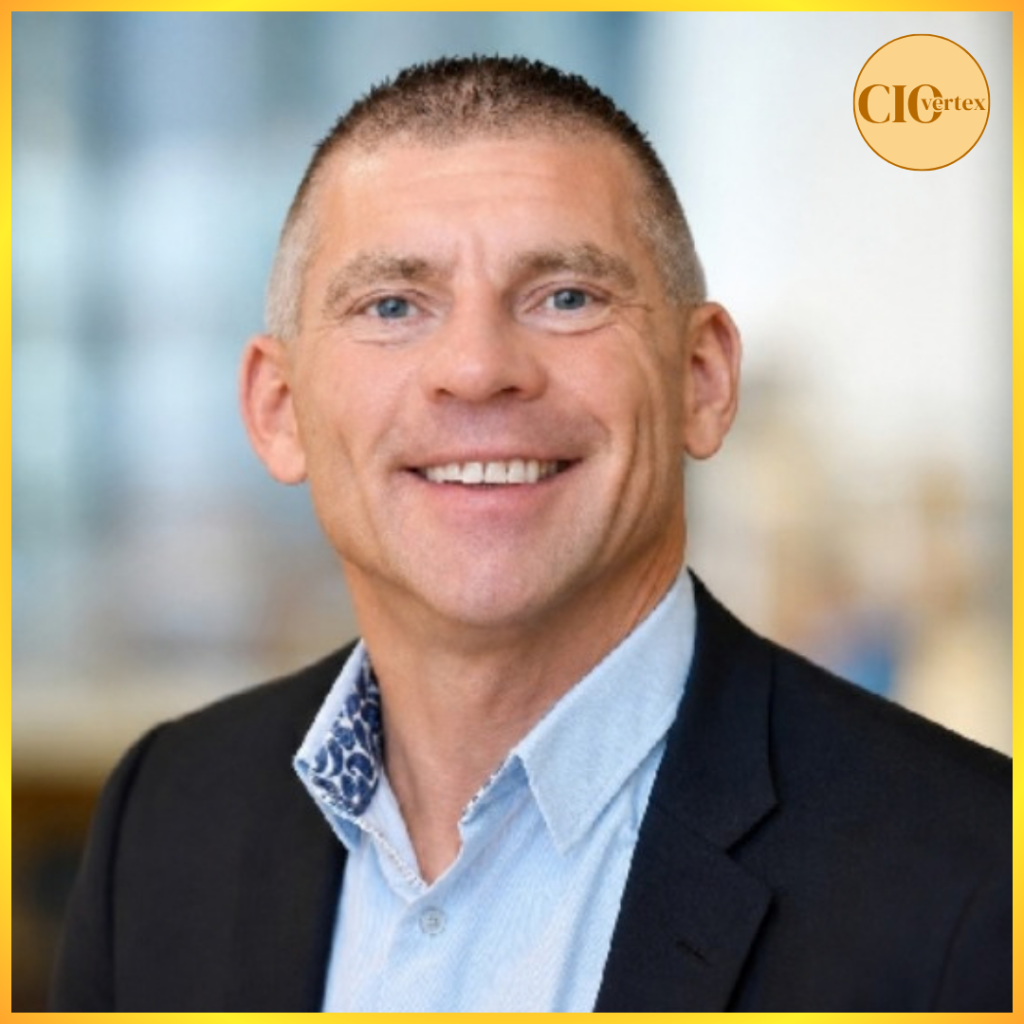
ABOUT PROFESSOR MICHAEL SHORT
Professor Michael Short is Professor of Control Engineering & Systems Informatics and Associate Dean (Research & Knowledge Exchange) at Teesside University. His work focuses on intelligent engineering, artificial intelligence, robotics, and sustainable technology, with a strong emphasis on real-world impact.