Introduction
Marketing has changed dramatically. Customer expectations move faster, technology continues to reshape the way companies compete, and artificial intelligence is challenging long-standing assumptions about how businesses communicate and grow.
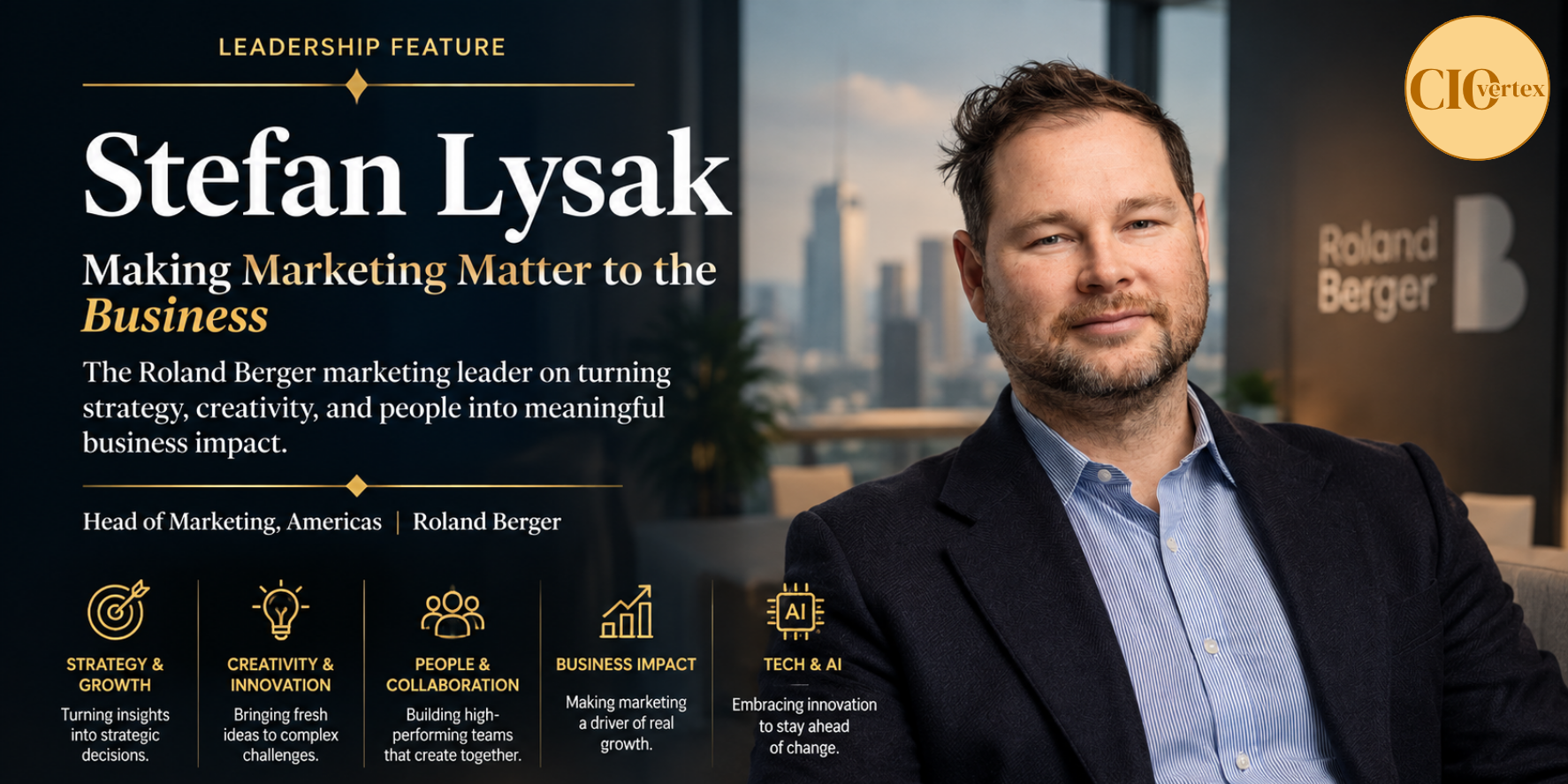
For Stefan Lysak, Head of Marketing, Americas at Roland Berger, that evolution makes marketing more interesting, not less.
He has always been drawn to the intersection of business, creativity, and people. But over the course of his career, his understanding of marketing has evolved from seeing it as a function that supports the business to recognizing its potential to actively shape where the business goes next.
For Stefan, that is where the real value of marketing begins.
From Creativity to Commercial Impact
Stefan’s attraction to marketing came naturally. It gave him a way to combine his interest in business and creativity with his fascination with people—to take complex ideas, make them relevant, and ultimately turn attention into something that creates value.
A pivotal shift came when he moved closer to the commercial side of the business.
It changed the way he looked at his profession.
Marketing was not simply about campaigns, communications, or making things look good. At its best, it could influence strategic decisions, bring the voice of the market into the organization, build trust, create demand, and contribute directly to growth.
That perspective has stayed with him.
Give Him a Messy Problem
Today, one of the questions Stefan cares most about is not whether marketing is busy, but whether marketing matters.
His job, in his view, is not to keep a marketing team occupied with activity. It is to make sure the function is helping the business move forward.
If there is one thing that seems particularly characteristic of Stefan’s leadership style, it is his appetite for complexity.
“I like messy problems. Give me an ambitious goal, a complicated challenge, and smart people in the room, and that’s usually where I have the most fun.”
It is a mindset that says a great deal about how he works.
Rather than looking for perfectly defined problems with obvious answers, Stefan enjoys situations where the path forward needs to be figured out. Complexity creates room for better questions, stronger collaboration, and more creative solutions.
As Head of Marketing, Americas at Roland Berger, he operates at precisely that intersection where brand, growth, technology, talent, and business strategy continuously influence one another.
And because the environment never stands still, neither does his approach.
When Marketing Earns Its Seat at the Table
For Stefan, one of the clearest signs of a successful marketing organization is when business leaders want marketing involved before a decision is made.
Not after the strategy has been finalized. Not when it is time to communicate it.
Earlier.
He considers it a meaningful achievement when colleagues turn to marketing and say, in effect: Bring marketing into this conversation early. We need them at the table.
That moment represents a shift in perception.
Marketing is no longer simply executing someone else’s strategy. It is helping shape the strategy itself.
This is the leadership perspective Stefan believes modern marketing executives need to embrace. The question is not simply, “What should we communicate?”
It is: “Where does the business need to go, and how can marketing help get it there?”
Building Teams That Build Together
That distinction can fundamentally change the role marketing plays inside an organization.
Stefan’s approach to leadership is closely connected to his belief in people.
He enjoys working with smart, ambitious individuals and creating environments where different perspectives can come together around difficult problems.
For him, great teams are not built by finding people who think alike. They are built by bringing together people who can challenge one another, contribute different strengths, and remain focused on a shared objective.
That philosophy has roots in an earlier chapter of his life.
Lessons from the Football Field
Before leading marketing organizations, Stefan experienced leadership through soccer.
Having played professionally when he was younger and later spending years coaching, he learned lessons that continue to influence his professional life.
Talent matters, but talent alone does not win.
Trust matters. Preparation matters. Resilience matters. So does the ability to remain composed when circumstances do not go according to plan.
Those lessons translate naturally into business.
Successful teams whether on a football field or inside an organization need people who understand their role, trust the people around them, and remain committed to something larger than individual achievement.
For Stefan, leadership is therefore as much about creating the conditions for others to succeed as it is about setting the direction.
Staying Curious When Everything Changes
The pace of change in marketing makes curiosity essential.
AI, data, new communication channels, and evolving customer behavior are reshaping the profession quickly. What worked yesterday may not necessarily work tomorrow.
Building Teams That Build Together
Stefan’s approach to leadership is closely connected to his belief in people.
He enjoys working with smart, ambitious individuals and creating environments where different perspectives can come together around difficult problems.
For him, great teams are not built by finding people who think alike. They are built by bringing together people who can challenge one another, contribute different strengths, and remain focused on a shared objective.
Lessons from the Football Field
Before leading marketing organizations, Stefan experienced leadership through soccer.
Having played professionally when he was younger and later spending years coaching, he learned lessons that continue to influence his professional life.
Talent matters, but talent alone does not win.
Trust matters. Preparation matters. Resilience matters. So does the ability to remain composed when circumstances do not go according to plan.
Those lessons translate naturally into business.
Successful teams whether on a football field or inside an organization need people who understand their role, trust the people around them, and remain committed to something larger than individual achievement.
For Stefan, leadership is therefore as much about creating the conditions for others to succeed as it is about setting the direction.
Staying Curious When Everything Changes
The pace of change in marketing makes curiosity essential.
AI, data, new communication channels, and evolving customer behavior are reshaping the profession quickly. What worked yesterday may not necessarily work tomorrow.
Stefan does not see that as a reason to become overwhelmed by change. He sees it as a reason to keep learning.
Curiosity allows him to question established assumptions, explore new possibilities, and remain open to ideas that may initially challenge his thinking.
That mindset also keeps the work interesting.
For someone who enjoys complicated problems, an industry that constantly creates new ones is hardly a disadvantage.
A More Complete Definition of Success
Earlier in his career, Stefan associated success more closely with traditional measures of progression—titles, advancement, and reaching the next professional milestone.
Today, the definition is broader.
Success means creating meaningful impact, building strong teams, continuing to learn, and working with people he respects.
It also means having a fulfilling life beyond work.
Family and personal life provide perspective, helping him maintain ambition without allowing professional achievement to become the only measure of a successful life.
That balance matters.
A career can be demanding without becoming all-consuming, and leadership can be ambitious without losing its human dimension.
Marketing Beyond the Next Campaign
Stefan believes one of the biggest misconceptions about marketing is that its primary purpose is communication.
The strongest marketing organizations go much deeper.
They understand customers and markets. They challenge assumptions. They build credibility. They create demand. They help clarify strategic choices. And they bring an outside perspective into conversations that might otherwise become too internally focused.
That is why Stefan believes marketing leaders need to think beyond the next campaign.
The modern marketing leader needs to understand the business well enough to identify where marketing can create genuine leverage.
It is less about producing more activity and more about creating the right impact.
That requires commercial awareness, creativity, strong relationships, and the confidence to challenge the organization when necessary.
Leading with Perspective
Despite the scale and complexity of his professional responsibilities, Stefan remains grounded in the things that exist outside the office.
Family provides perspective. Soccer has reinforced his understanding of teamwork and resilience. And stepping away from work creates the space to return with greater clarity.
For him, those things are not separate from leadership. They contribute to it.
The best leaders are not defined solely by what they accomplish professionally. They are also shaped by how they treat people, how they respond under pressure, and what they value when the workday ends.
The Road Ahead
Stefan does not believe successful careers need to follow a perfectly mapped-out path.
Some of the most valuable opportunities appear when people are willing to say yes before they feel completely ready.
His advice to emerging professionals reflects that philosophy: stay curious, take calculated chances, build meaningful relationships, and never stop learning.
Be ambitious, but be generous with credit.
Become someone people genuinely want to work with.
And do not be afraid of complicated problems. Sometimes the messiest challenges are where the most interesting opportunities are found.
For Stefan Lysak, meaningful leadership ultimately comes down to creating impact turning curiosity into action, helping marketing become a genuine strategic partner, building teams that make one another better, and leaving the organizations and people around him stronger than he found them.
Because the real measure of marketing leadership is not how much activity a team creates.
It is how much difference that activity makes to the business.

ABOUT STEFAN LYSAK
Stefan Lysak is the Head of Marketing, Americas at Roland Berger, bringing together strategy, creativity, and commercial thinking to drive meaningful business impact. His leadership focuses on building strong teams and positioning marketing as a strategic partner to business growth.